
Arbitration Bulletin 2024
Authors: Melissa Balıkçı Sezen, Mehveş Erdem Kamiloğlu, Duygu Öner Ayçiçek, Tilbe Birengel
Developments in Türkiye
Important Court Decisions
The Constitutional Court Ruled That the Legal Provision on Proportional Fees for the Enforcement of Foreign Court Judgments is Constitutional
A request was submitted for the annulment of Article 4 of the Fees Law No. 492, which regulates the collection of proportional fees for the enforcement of foreign court judgments, on the grounds that it violates Articles 2 and 36 of the Constitution—pertaining respectively to the rule of law and the right to legal remedies.
The Constitutional Court[1] made the following findings:
- The criteria and the schedule according to which the fee to be paid for the judgment for which enforcement is requested shall be determined are clear, explicitly, specific, accessible and foreseeable in a way that leaves no room for any hesitation. There is nothing contrary to the constitutional principle that fundamental rights and freedoms must be restricted by law.
- The rule stipulating that the cases to be filed for the enforcement of foreign court judgments shall be subject to a fee in accordance with the tariff numbered (1) according to the value of the matter adjudicated, aims to reduce the workload of the judicial authorities. Reducing the workload of judiciary has a public benefit. In this respect, the rule is based on a legitimate purpose.
- When the financial burden to be borne by the parties is compared with the public interest in completing the proceedings as soon as possible, the levying of proportional fees in the enforcement of foreign court judgments does not impose an excessive burden on the parties to the enforcement proceedings. There is no disproportionality between the public interest sought to be achieved by this regulation and the burden imposed on the parties to the proceedings. Therefore, there is no disproportionate interference with the right to property and the right of access to court.
The Court of Cassation Ruled That Arbitral Tribunals Have Jurisdiction to Hear Actions for Annulment of Objection and to Award Enforcement Denial Compensation
The Court of Cassation[2] made the following findings:
- Actions for annulment of objection are arbitrable, and where there is an arbitration agreement between the parties, the creditor may initiate such an action through arbitration.
- The arbitral tribunal is authorized not only to adjudicate actions for annulment of objection, but also to award enforcement denial compensation.
- Enforcement denial compensation is a type of compensation arising from compulsory enforcement law, established to prevent unnecessary occupation of courts and enforcement offices. Therefore, an arbitral tribunal that is competent to hear an action for annulment of objection should also be deemed competent to award enforcement denial compensation as a consequence of such proceedings.
- Although there is no provision preventing the initiation of enforcement proceedings in a dispute subject to an arbitration agreement, in the event that the debtor raises an objection, an action for annulment of objection must be brought through arbitration.
The Court of Cassation Ruled That the Arbitration Clause in a Franchise Agreement Is Also Applicable to Unfair Competition Disputes
The 11th Civil Chamber of the Court of Cassation[3] upheld the following findings of the court of appeal, which held that the arbitration clause is not limited solely to the contract itself, but also covers disputes arising from the relationship between the parties:
- The arbitration clause in the franchise agreement encompasses all disputes arising from the relationship between the parties and is not confined solely to the contractual terms.
- The claimant’s allegations of unfair competition are not independent from the contractual relationship between the parties. Therefore, due to the broad scope of the arbitration clause, such unfair competition claims are also subject to arbitral jurisdiction.
The Court of Cassation Ruled That the Nature of the Leased Property Must Be Determined to Classify the Type of Lease and Assess Whether the Dispute is Arbitrable
The Court of Cassation[4] made the following findings:
- There is no legal provision that explicitly prohibits arbitration of disputes arising from lease agreements. In determining whether such disputes are arbitrable, it must be assessed whether the subject matter of the dispute is within the scope of the parties’ will. To make this assessment, the nature of the leased property must be identified and the type of lease must be determined accordingly.
- In lease-related disputes, matters that are not subject to the will of the lessee and lessor and that fall within the scope of public order are not considered arbitrable.
To determine the rent amount for the period subject to arbitration proceedings and whether any overpayment has occurred, it must first be determined whether the dispute is arbitrable. Within this respect, the type of lease that is the subject of the dispute must be identified. If the lease agreement qualifies is classified as a residential premises and covered workplace lease (i.e., a commercial lease), then mandatory statutory provisions governing these types of leases must be taken into account. A request for annulment of the arbitral award shall be reviewed under Articles 408(1) and 439(2)(g) of the Code of Civil Procedure. In cases where the lease relates to other types of leases, the dispute is considered arbitrable.
the Arbitral Tribunal’s Application of the Doctrines of Excessive Hardship of Performance or Adaptation of the Lease Agreements Does Not Indicate That the Tribunal Rendered Its Award Based on Equity Rather Than Substantive Law
The Court of Cassation[5] made the following findings:
- The arbitration agreement between the parties does not contain an explicit provision authorizing the arbitral tribunal to resolve the dispute according to principles of equity. There is no legal obstacle to the arbitral tribunal resolving the specific dispute by applying substantive legal doctrines such as excessive hardship of performance or adaptation of the agreements.
- Resolving the dispute by applying the principles of equity within the framework of substantive law does not mean that the arbitral tribunal disregarded or failed to apply substantive legal rules.
The Court of Cassation Ruled That a Compensation Claim Arising from a Construction Contract in Return for Land Share Is Arbitrable
The Court of Cassation[6] held that a compensation claim arising from a construction contract in return for land share does not concern in rem rights over immovable property, and is therefore arbitrable.
The Court of Cassation Ruled That a Dispute Concerning the Transfer of Ship Ownership Is Arbitrable
The Court of Cassation[7] stated that, with the exception of Article 937 of the Turkish Commercial Code (TCC), under Article 936 of the TCC, all ships are subject to the legal regime governing movable property. Accordingly, disputes concerning the transfer of ship ownership are arbitrable.
The Court of Cassation Ruled That an Arbitral Award May Be Subject to Annulment Proceedings Even If It Is Unenforceable Due to the Absence of Mandatory Formal Requirements
The Court of Cassation[8] made the following findings:
- Failure to comply with Article 436 of the Turkish Code of Civil Procedure (CCP), which regulates the form, content, and required elements of an arbitral award, is not explicitly listed as a ground for annulment. However, the fact that an award does not comply with formal requirements does not preclude the assertion of annulment grounds or the annulment of the award.
- Even if an arbitral award completely lacks the mandatory formal requirements and is therefore unenforceable, it may still be subject to annulment proceedings.
- From the perspective of the party to the dispute, there is a legitimate legal interest in seeking annulment, even if the arbitral award is not enforceable. For individuals the resolution and definitive conclusion of a dispute in which they are a party ensures legal certainty. Otherwise, as long as an arbitral award lacking formal requirements continues to exist, it may cause legal uncertainty and discomfort for the parties involved. Therefore, there is a legitimate legal interest in initiating an annulment action against such an award.
The Court of Cassation Ruled That the First Objection to Arbitration Produces Legal Effect Only with Respect to the Parties to the Arbitration Agreement
The Court of Cassation[9] held that it was incorrect to dismiss the case on procedural grounds based on the first objection to arbitration with respect to defendants who are not parties to the arbitration agreement. The arbitration agreement and the related objection are only effective between parties bound by the arbitration agreement.
The Regional Court of Appeal Ruled That Initiating Mandatory Mediation Does Not Constitute a Waiver of the Arbitration Agreement
The Regional Court of Appeal[10] held that mandatory mediation does not constitute a waiver of the arbitration agreement or of the parties’ intention to arbitrate, as it is not a proceeding aimed at resolving the merits of the dispute. Applying for mandatory mediation is a procedural requirement and cannot be interpreted as abandoning the arbitration agreement.
The Regional Court of Appeal Ruled That, In Cases Where A Provisional Measure Is Granted by A Turkish Court Before The Commencement Of Arbitration Proceedings Governed By The International Arbitration Law (IAL), Any Objection Raised Against This Measure After The Commencement Of Arbitration Proceedings Falls Within The Jurisdiction Of The Court
The Regional Court of Appeal[11] made the following findings:
- When Article 6 of the Turkish International Arbitration Law (IAL) and its reasoning are examined, it is understood that the arbitrator or the arbitral tribunal does not have the authority to modify or annul a provisional measure granted by the court.
- In cases where a provisional measure is granted by a Turkish court before the arbitration proceedings commence, if the arbitration proceedings later begin abroad and the objection to the provisional measure cannot be evaluated in Turkiye, this would deprive the parties of the protection provided by the measure.
- Despite the existence of an arbitration agreement, a party may request a provisional measure from Turkish courts in relation to a dispute involving a foreign element.
- Regardless of whether arbitration proceedings have been initiated, Turkish courts are authorized to evaluate objections to provisional measures issued by Turkish courts.
Important Developments on Legislation and Arbitration Rules
The Istanbul Chamber of Commerce Arbitration and Mediation Center (ITOTAM) Updated Its Arbitrators’ and Administrative Fees Tariff
The ITOTAM Arbitrators’ Fee Tariff and Administrative Cost Tariff[12] was updated and entered into force on 17.04.2024.
The maximum limit for the total amount of claims required for the application of the Arbitration Rules for Simple Legal Disputes was increased from TRY 500,000 to TRY 2,000,000.
A cooperation agreement was signed between ITOTAM and the Russian Institute of Modern Arbitration (RIMA)
In June 2024, ITOTAM[13] expanded its international cooperation by signing a cooperation agreement with RIMA.
ISTAC Published an Announcement Regarding Cases Filed in Foreign Currency
In its meeting dated 08.08.2024, the Istanbul Arbitration Centre (ISTAC)[14] decided that, including pending cases, in disputes where the claim is denominated in a foreign currency, the most qualified arbitrators shall be appointed, and to mitigate the effects of exchange rate fluctuations, the initially determined arbitration costs shall be recalculated based on the Turkish Central Bank’s effective selling rate applicable on the date the proceedings are concluded.
The Communiqué on the International Arbitration Fee Tariff was Published in the Official Gazette on 07.03.2024.
According to the published communiqué[15], arbitrators’ fees are determined based on the value of the dispute, with different rates applying for a sole arbitrator and for tribunals consisting of three or more arbitrators. For the first TRY 500,000, the fee is 5% for a sole arbitrator and 8% for three or more arbitrators. For higher brackets, the rates decrease progressively, and for amounts exceeding TRY 10,000,000, the applicable rates are 0.1% for a sole arbitrator and 0.2% for panels of three or more arbitrators.
Developments in the World
Important Court Decisions and Arbitral Awards
Decisions of the United Kingdom Supreme Court
- UniCredit Bank GmbH v RusChemAlliance (RCA) Decision
The United Kingdom Supreme Court[16] upheld the decision of the Court of Appeal of England and Wales, which granted a provisional measure requested by UniCredit against the proceedings initiated by RCA in Russia. The case addressed the questions of whether the arbitration agreement was governed by English law or the law of the seat of arbitration, which was French law, and whether England was the appropriate forum for such a provisional measure. The Supreme Court held that, in cases where the parties have chosen English law as the law applicable to the arbitration agreement, English courts have the authority to grant a provisional measure.
Investment Arbitration Decisions
- Heirs of the Sultan of Sulu v. Malaysia Decision
The French Court of Cassation[17] rejected the appeal filed by the heirs of the former Sultan of Sulu regarding a compensation claim of approximately 15 billion USD arising from a land agreement dated 1878. The heirs had obtained a 14.9 billion USD award from an arbitral tribunal in France in 2022. However, the Paris court accepted Malaysia’s objection and ruled that the award was invalid. The French Court of Cassation upheld this decision, ruling that the award was unenforceable and invalid.
- Blasket Renewable Investments LLC v. Kingdom of Spain
In its decision dated 16.08.2024, the U.S. Court of Appeals[18] for the D.C. Circuit addressed the issue of whether arbitral awards rendered under the Energy Charter Treaty (ECT) in intra-EU disputes can be enforced in U.S. federal courts. The case arose in the context of Spain facing multiple arbitral awards under the ECT, amounting to over USD 390 million. The Court first found that U.S. federal courts have jurisdiction over ECT arbitral awards under the Foreign Sovereign Immunities Act (FSIA). However, it did not rule on the merits of whether the awards could be enforced in the U.S., leaving that determination to the lower courts. The decision also noted that not every investment treaty necessarily provides a structure suitable for enforcement in U.S. courts.
- Aroma Franchise Company, Inc. v. Aroma Espresso Bar Canada Inc. Decision
The Ontario Court of Appeal[19] overturned the decision of the lower court, which had set aside an arbitral award in the Aroma Franchise case due to a situation allegedly affecting the arbitrator’s impartiality. In this case, the sole arbitrator accepted an appointment in another case as a sole arbitrator, based on a proposal made by the lawyer of one of the parties during the ongoing arbitration, without disclosing this to the parties. The other case involved different parties and had an unrelated subject matter. The Court emphasized that an arbitrator’s duty of disclosure is based on an objective standard, independent of the subjective expectations of the parties. Referring to the UNCITRAL Model Law, the Court noted that the principle of judicial impartiality also applies to arbitrators. It held that the arbitrator’s acceptance of the second arbitration did not give rise to justifiable doubt of bias, and therefore, the decision to set aside the award lacked legal basis. The ruling constitutes an important precedent regarding impartiality and the duty of disclosure in arbitration.
Important Developments on Arbitration Institutions and Rules
The Netherlands Arbitration Institute (NAI) Amended Its 2024 Arbitration Rules
As of 31.12.2024, editorial amendments were made to the NAI Arbitration Rules[20]. These changes aimed to eliminate ambiguities in the rules and make them clearer and more understandable. In this context, the time limits and methods for arbitrator appointments were clarified. It was further regulated that the arbitral tribunal may request security from each party for arbitration costs and legal aid costs, and that the tribunal may rule on legal aid costs even if a party has not expressly requested such a decision.
Singapore International Arbitration Centre (SIAC) Announced the 2025 Arbitration Rules
The Singapore International Arbitration Centre (SIAC)[21] has announced the SIAC Rules 2025, which entered into force on 01.01.2025. The new rules introduce new procedures and expand the scope of the existing Expedited Arbitration Procedure. Provisions encouraging parties to engage in mediation have been added. SIAC Gateway has been integrated as an online case management system, and various mechanisms have been introduced to enhance the efficiency of arbitration proceedings.
Hong Kong International Arbitration Centre (HKIAC) 2024 Arbitration Rules Entered into Force
The HKIAC 2024 Arbitration Rules, aimed at ensuring that arbitrations administered by HKIAC are conducted in a flexible and cost-effective manner, entered into force on 01.06.2024.[22]
Equatorial Guinea Ratified the ICSID Convention
On 24.07.2024, Equatorial Guinea announced that it had ratified the Convention on the Settlement of Investment Disputes between States and Nationals of Other States (ICSID Convention). As a result, the number of states party to the ICSID Convention increased to 159. The Convention entered into force for Equatorial Guinea on 23.08.2024.[23] The ICSID Convention provides an independent and impartial platform for the resolution of disputes concerning foreign investments, regulating arbitration and other alternative dispute resolution mechanisms. As a state party to ICSID, Equatorial Guinea will participate in the administration of the Centre and will have a representative on its Administrative Council, the institution’s governing body.
Amendments Proposed to the UK Arbitration Act
A Bill proposing amendments to the United Kingdom Arbitration Act[24] 1996 has been submitted to Parliament.
The Bill includes provisions regarding the clarification of court powers in arbitration proceedings, emergency arbitrators, appeals in applications for stays of legal proceedings, and time limits for applications challenging arbitral awards. The Bill aims to enhance the United Kingdom’s competitiveness in the field of international arbitration.
IBA Guidelines on Conflicts of Interest Were Updated
The IBA Guidelines on Conflicts of Interest have been updated[25], and the 2024 version has been published. The Guidelines, which serve as a reference in practice for arbitrators’ disclosure obligations and conflict of interest checks, have been revised and new provisions have been introduced.
Amendments Made to the 2024 Arbitration Rules of the China International Economic and Trade Arbitration Commission (CIETAC)
The China International Economic and Trade Arbitration Commission (CIETAC) introduced significant amendments to its arbitration rules, which entered into force on 1 January 2024.[26] Compared to the 2015 Rules, the 2024 Rules were expanded from 84 to 88 articles, incorporating recent developments in international arbitration, such as third-party funding (Article 48) and early dismissal (Article 50).
These amendments aim to provide parties with greater flexibility, autonomy, and efficiency in CIETAC arbitrations, and to ensure alignment with international standards.
London Court of International Arbitration (LCIA) Published New Equality, Diversity, and Inclusion (EDI) Guidelines Aimed at Increasing Inclusivity in International Arbitration
The London Court of International Arbitration (LCIA)[27] announced on 04.12.2024, the publication of new Equality, Diversity, and Inclusion (EDI) Guidelines aimed at increasing inclusivity within the international arbitration community.
These guidelines offer flexible, non-binding recommendations to encourage the application of EDI principles at all stages of the arbitration process.
ICSID and SCCA Signed Cooperation Agreement for the Resolution of International Investment and Commercial Disputes
The International Centre for Settlement of Investment Disputes (ICSID) and the Saudi Center for Commercial Arbitration (SCCA)[28] signed an agreement on 06.03.2024, to jointly support the use of arbitration, mediation, and other dispute resolution mechanisms in the resolution of international investment and commercial disputes. This agreement is the latest cooperation arrangement aimed at promoting information exchange and providing practical assistance in cases between ICSID and leading local and regional dispute resolution institutions. Based on Article 63 of the ICSID Convention, the agreement offers parties the option of holding hearings at the SCCA’s facilities in ICSID proceedings.
Singapore International Arbitration Centre (SIAC) Announced the Official Publication of the 7th Edition of the SIAC Rules 2025
The Singapore International Arbitration Centre (SIAC) announced on 09.12.2024, the official publication of the 7th edition of the SIAC Arbitration Rules[29] (2025 SIAC Arbitration Rules). These rules entered into force on 01.01.2025.
The 2025 SIAC Arbitration Rules allow parties to request protective orders (PPO) from an emergency arbitrator without notifying the other party.
Lebanese Arbitration and Mediation Centre (LAMC) Published Updated 2024 LAMC Arbitration Rules
The Lebanese Arbitration and Mediation Centre (LAMC)[30] published the updated 2024 LAMC Arbitration Rules, which came into effect on 01.07.2024. These rules define and regulate the management of cases submitted to the LAMC Arbitration Panel as of 01.07.2024. The new rules consist of ten sections and 65 rules, including three special annexes.
You can download PDF version of the bulletin here.

- Constitutional Court, E.2024/104, K.2024/173, 17/10/2024.
- 11th Civil Chamber of Court of Cassation, E. 2024/212, K. 2024/2703, 03.04.2024.
- 11th Civil Chamber of Court of Cassation, E. 2022/5141, K. 2024/1641, 29.02.2024.
- 3th Civil Chamber of Court of Cassation, E. 2023/4108, K. 2024/2037, 26.06.2024.
- 3th Civil Chamber of Court of Cassation E. 2024/741, K. 2024/1179, 19.03.2024.
- 6th Civil Chamber of Court of Cassation E. 2023/664, K. 2024/2585, 10.09.2024.
- 6th Civil Chamber of Court of Cassation E. 2024/1210, K. 2024/1693, 23.5.2024.
- 6th Civil Chamber of Court of Cassation E. 2024/1885, K. 2024/2306, 26.06.2024.
- 11th Civil Chamber of Court of Cassation E. 2023/5030, K. 2024/6919, 30.09.2024.
- Istanbul Regional Court of Appeal 17th Civil Chamber E. 2023/1565, K. 2024/294, 29.02.2024.
- İstanbul BAM 15. HD, E. 2024/294, K. 2024/268, 27.03.2024.
- You can read for changes as of 17.04.2024 in Turkish here.
- You can access here.
- You can access here.
- You can access here.
- You can access here.
- You can access here.
- You can access here.
- You can access here.
- You can access here.
- You can access here.
- You can access here.
- You can access here.
- You can access here.
- You can access here.
- You can access here.
- You can access here.
- You can access here.
- You can access here.
- You can access here.
All rights of this article are reserved. This article may not be used, reproduced, copied, published, distributed, or otherwise disseminated without quotation or Erdem & Erdem Law Firm's written consent. Any content created without citing the resource or Erdem & Erdem Law Firm’s written consent is regularly tracked, and legal action will be taken in case of violation.
Other Contents

Authors: Melissa Balıkçı Sezen, Mehveş Erdem Kamiloğlu, Duygu Öner Ayçiçek, Tilbe Birengel

Authors: Melissa Balıkçı Sezen, Tilbe Birengel, Mehveş Erdem Kamiloğlu, Duygu Öner Ayçiçek, Ece Özsü, Ceren Eke

Authors: Prof. Dr. H. Ercüment Erdem, Melissa Balıkçı Sezen, Mehveş Erdem Kamiloğlu, Tilbe Birengel

Authors: Melissa Balıkçı Sezen, Tilbe Birengel, Mehveş Erdem Kamiloğlu
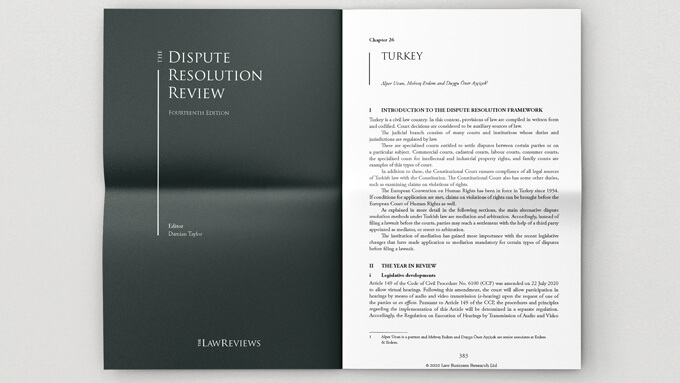
Authors: Alper Uzun, Mehveş Erdem, Duygu Öner Ayçiçek